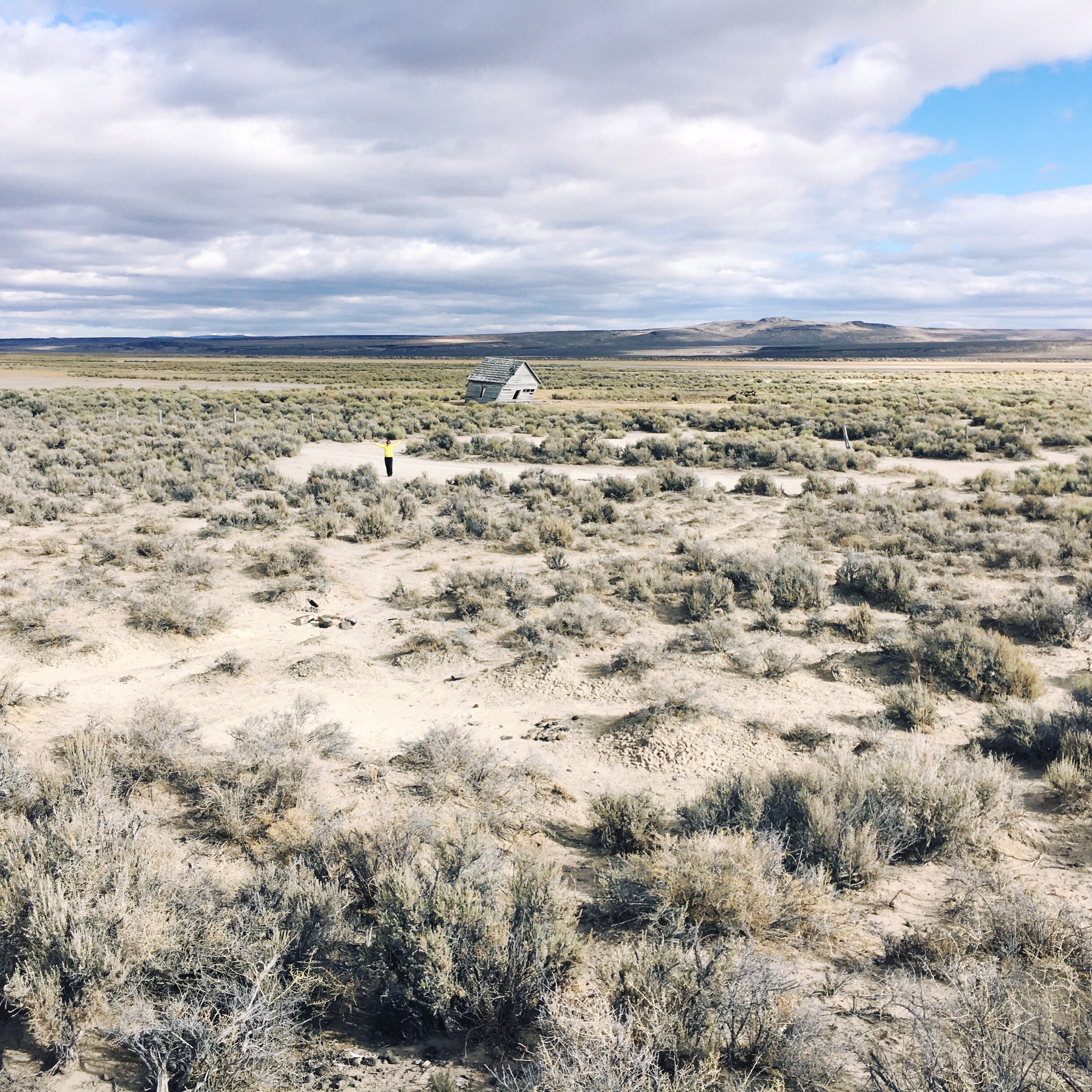


How did this striking place become Massacre Lakes? Well, you might guess. From Nevada Place Names: A Geographical Dictionary by Helen S. Carlson (Why don’t I own this book? Although this entry luckily included in the Google Books preview, page 164):
“A large and well-equipped wagon train was attacked near here in 1850 by Indians of the High Rock Canyon country. Forty men of the emigrant party were killed in the battle and interred in a common grave.”
So there you have it. Somewhere nearby there is a mass grave (I think if human history has taught us anything, one thing you can expect near a massacre site is a mass grave). But knowing more raises questions. Why was the train particularly “well-equipped”? How is it that exactly “40” “men” were killed. How many survivors were there? How many native casualties? What are the sources? (They of course are given, but the citation page isn’t in the Google Books preview so that will have to wait until I get to the library.) If it were a “massacre” then why does the source say “battle”?
Some of these things are surely just lost in the past, carried away by the persistent and prevalent wind, but don’t we owe it to ourselves to learn what we can?

 overland passages
Our family had a relative’s (Great + Grandmother)diary that had a diary with detailed description of the massacre, cause of the massacre, and aftermath for the survivors. I am in the process of recovering the diary or a copy, and hope to recover it and put an end to conjecture. In the 1970’s, my Dad and I took a copy and Metsker maps to Northern Nevada and found Massacare Lake, but no sign of the battle despite of a pretty good description of the area(NW edge of the lake). Metal detectors may have helped, but we had none. After a couple days searching, we gave up and followed the diary towards New Years Lake. The diary said then survivors were fed, sheltered, and cared for by the tribe at new Years Lake until spring when they were able to cross the Warner Mts to a fort where they were turned over to soldiers. Both the traveler’s story and the native’s story matched up, and the natives were allowed to return to their village with no punishment. We had trouble gaining access to the lake on an old road(shotgun wielding land owner), decided to pursue it through other channels and never returned.
The description in the diary of the massacre to the best of my memory: The natives had fed the wagon train with wocus and venison for several weeks(the train was trapped by snow in the Warners) when, as was their custom, one of the natives took an piece of clothing in recompense for food. Upon discovery by a couple of the men from the train who thought he was stealing, a fight broke out and the native was shot, despite some of the women from the train trying to calm the men down. Th natives fled, but returned later to recover the body, but the men fired on, them again, starting a battle in which most of the men from the wagons were killed. The women and children were treated well, and this probably saved the natives from prosecution
LikeLike